An Nahw Al Wadih Pdf Editor
Writer Ali Al Jaram Mustafa Ameen book Al nahw ul wazeh dars e nizami deoband PDF format. تسهيل النحو Tasheel Un Nahw. Various grammar works including al-Nahw al-Wadih.
Mawlana ‘Aamir Bashir was kind enough to provide his new translation of the book Tasheel al-Nahw for free download.Although he didn’t ask for it, it is befitting that we keep such sincere scholars who write and distribute knowledge for free in our du’as. Below I have included the introduction from the book: Introduction to the Text & Translation This book is a revised edition of Tasheel al-Nahw, which in turn is a somewhat expanded translation of the Urdu language primer of Arabic grammar, ‘Ilm al-Nahw by Mawlana Mushtaq Ahmad Charthawali. Mawlana Charthawali’s primers for Nahw (Arabic grammar) and Sarf (Arabic Morphology) are standard textbooks in Western madrasahs. The original English translation of ‘Ilm al-Nahw was prepared by scholars from Madrasah Islamiyyah, Benoni, South Africa. They put in a lot of hardwork and made the English translation much more beneficial than the Urdu original. May Allah reward them.
I bought a lock for the chest. RULE 22: The noun is majrur (genitive) if it is preceded by one of the following particles of genitivity (huruf jarr): min (from), ila (to), an (from), ala (on, upon), fi (in), the ba (with a kasrah, i.e. Bi: meaning with or by ), and the lam (with a kasrah, i.e. Li: meaning for or belongs to ).
The latter forbids the doing of an action. RULE 16: In ( if ) causes two fi l mudari to be majzum. Its meaning is that the occurrence of the first verb is a condition for the occurrence of the second verb. LESSON 12: RAF (NOMINATIVE CASE) OF THE FI L MUDARI 1. The dove flies. The traveller returns. The clouds move.
Al-Nahw al-wadih (The Clear Arabic Grammar), Primary Level, Part One, Page 7 of 11 8 LESSON 13: KANA AND ITS SISTERS 1. The congestion is severe. The congestion was severe. The house is clean. The house was clean.
If your brother travels, you will travel with him. RULE 14: The fi l mudari becomes majzum (takes the jussive case) when it is preceded by a harf jazim (jussifying particle) such as the following (three): lam (particle of negation), la of forbiddance, and in ( if ). RULE 15: Lam (particle of negation) and the la of forbiddance each cause one fi l mudari to be majzum. The former negates the occurrence of an action in the past.
An Nahw Al Wadih
RULE 9: The mubtada (subject of a sentence) is an ism marfu (noun in the nominative case) at the beginning of the sentence. RULE 10: The khabar (predicate) is an ism marfu (noun in the nominative case) that, along with the mubtada, forms a complete sentence (jumlah mufidah).
The flower became (began the evening) withering. The clouds are thick. The clouds became thick (in the forenoon). The road is congested. The road became congested (in the forenoon). The rain is heavy. The rain was heavy all day.
RULE 23: The na t (adjective) signifies an attribute of the ism (noun) preceding it; the attributed noun is known as man ut. RULE 24: The na t follows the man ut in its raf, nasb and jarr (i.e. The adjective follows the noun in its being nominative, accusative and genitive). END OF PART ONE, PRIMARY LEVEL Translator s Note: Terms like marfu, mansub, majrur and majzum are only approximately translated by the terms nominative, accusative/subjunctive, genitive, jussive etc. Since the latter are from the grammar of European languages, especially Latin.
The pdf is available. I hope this helps. Wassalam Aamir.
The cattle moved to the field. Crack fifa 2002 free download. The soldier comes down from the horse. Fear goes away from the child.
We play with the ball. We walk in the fields. The dog barks. The guard becomes alert. The girl eats.
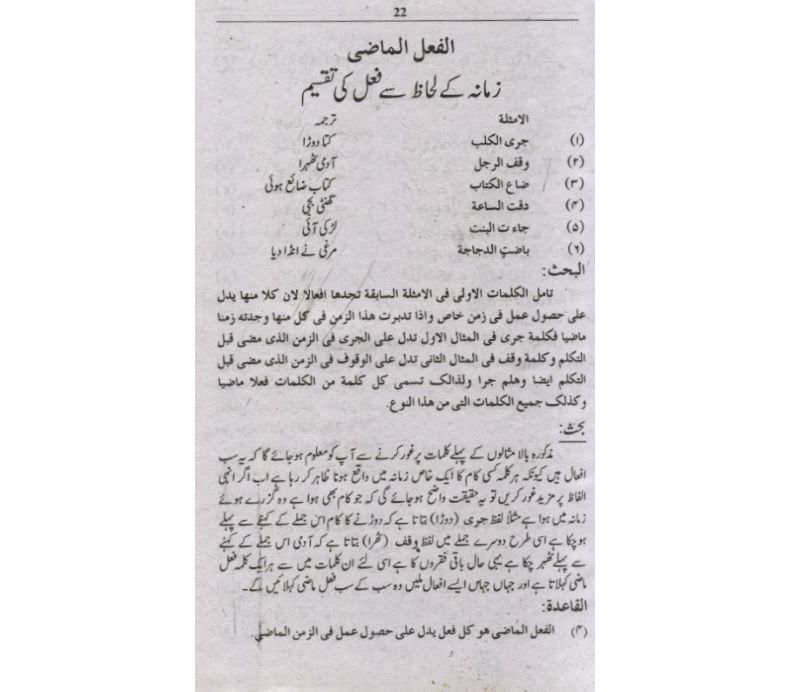
Al-Nahw al-wadih (The Clear Arabic Grammar), Primary Level, Part One, Page 2 of 11 3 LESSON 3: CLASSIFICATION OF THE VERB WITH REGARD TO ITS TIME- PERIOD 3.1 THE FI L MADI (PAST TENSE) 1. The man stopped.
No one caught the burglar. Do not eat when you are full. Do not laugh a lot. Do not travel (too) fast. If you open the windows of the room, its air will freshen. If you sit in the path of the draught, you will fall ill.
The book became lost (went missing). The clock chimed. The girl came. The hen laid [(an) egg(s)]. RULE 4: The fi l madi (past tense) is every verb that signifies the occurrence of an action in the past.
The wood floats on the water. The fruit falls on the earth. The dog barks in the garden.
So, please, wait for a couple more months. Then, insha Allah, you can publish both. Secondly, before I give you the editable file, I’d like to know more about you. What is your background? Where are u based?
Some brothers have been contacting me about publishing “Tasheel al-Nahw” and “Ten Lesson.” I just wanted to mention that I am in the process of editing both. Their current online versions are useable but they do need improvement, and there are some mistakes. I am teaching both this year, and while teaching I am making the necessary adjustments. As I move along the process of editing, I post new versions online at ilmresources.wordpress.com. I hope to complete the revision of “Tasheel al-Nahw” and “Ten Lessons” by the middle of May this year, insha Allah. Currently, ver 1.4 of Tasheel al-Nahw is online which has been revised up to the end of chapter 3.
The student of Arabic grammar is therefore advised to concentrate on the Arabic terms and not to worry about the English/Latin terms; the approximate translations of these Arabic terms are primarily provided for the benefit of those who are already familiar with the grammatical terms of the European languages. Version Muharram 1423 / 25 March Version th Rajab 1428 / 9 th August, 2007 Al-Nahw al-wadih (The Clear Arabic Grammar), Primary Level, Part One, Page 11 of 11.
The rose withers. 3.2 THE FI L MUDARI (PRESENT TENSE) RULE 5: The fi l mudari (present tense) is every verb that signifies the occurrence of an action in the present or future. It must begin with one of the letters of the mudari: hamzah, nun, ya or ta. 3.3 THE FI L AMR (IMPERATIVE TENSE) 1.
The cold became intense. The servant is strong. The servant is not strong. The worker is energetic. The worker is not energetic. The glutton is ill. The glutton became (began the morning) ill.
I will never lie. The lazy one will never succeed. I will never hit the cat. In that case, you will stay with us. (In reply to someone saying: I shall visit your city.) 8. In that case, your trade will profit. (In reply to someone saying: I shall be trustworthy).
May Allah reward them. At least two versions of this translation are available online. The first one had many errors and typing issues. The newer version has made some improvements but issues remain, especially with regards to language and clarity of the English and Arabic texts. We decided to bring out a revised edition of this translation to address these issues. During the course of our revision and editing, we consulted various grammar works including al-Nahw al-Wadih, Sharh ibn ‘Aqeel, Mu‘jam al - Qawa‘id al - ‘Arabiyyah, and A Simplified Arabic Grammar of Mawlana Hasan Dockrat.
The garment is short. The garment became short. The cold is intense.
The lightning flashed. The wolf howled. The snow falls. The cold intensifies. Pluck the rose. Take the book. LESSON 8: THE JUMLAH FI LIYYAH (VERB-BASED OR VERBAL SENTENCE) RULE 11: Every sentence consisting of a verb (fi l) and its subject (fa il) is called a jumlah fi liyyah (verb-based or verbal sentence).
RULE 18: Kana ( was, past tense of to be ) operates on the mubtada (subject) and khabar (predicate): it causes the former, which is then called its ism (ism of kana), to be marfu (nominative); it causes the latter, which is then called its khabar (khabar of kana), to be mansub (accusative). RULE 19: Similar to kana as above are: sara (became), laysa (is not), asbaha (to be/become in the morning), amsa (to be/become in the evening), adha (to be/become in the forenoon), zalla (to be, all day) and bata (to be, all night); these verbs are called the sisters of kana (akhawat kana). RULE 20: Each of these verbs (in the madi, past tense) has a mudari (present) and amr (imperative) form that operates in the same way as the madi, except for laysa, which has neither a mudari nor an amr form. Al-Nahw al-wadih (The Clear Arabic Grammar), Primary Level, Part One, Page 8 of 11 9 LESSON 14: INNA AND ITS SISTERS 1. The camel is (extremely) patient. Indeed, the camel is (extremely) patient. The pyramid is ancient.
We have completely revised some sections, as well as a number of definitions. The organization has been changed in a way that we feel will make it easier for the student to understand how each section fits in the overall picture. This is a beginner-to-intermediate level text; therefore, we have not transliterated Arabic words exactly, keeping in mind that most people at this stage will not be comfortable with Arabic transliteration schemes.
The ship sails on the water. Do you like travelling? LESSON 2: PARTS OF THE SENTENCE RULE 3: Words are of three types: ism (noun/adjective), fi l (verb) and harf (particle). A) The ism is every word by which a person, animal, plant, inanimate object or anything else is named. B) The fi l is every word that signifies the occurrence of an action at a particular time. C) The harf is every word whose meaning is not completely clear without other (accompanying) words.
An Nahw Al Wadih Part 2
Date-palms are plentiful in Egypt. RULE 1: The composition that gives a complete meaning is called a jumlah mufidah (complete sentence); it is also called kalam (speech). RULE 2: The complete sentence is composed of two or more words; every word is counted as part of it (the sentence). Ibrahim rode the horse. Isma il teases the cat. The farmer reaps the wheat.
At least two versions of this translation are available online. The first one had many errors and typing issues. The newer version has made some improvements but issues remain, especially with regards to language and clarity of the English and Arabic texts.
As for duals and plurals of Arabic words, we have not used the original Arabic duals and plurals; rather, their plurals have been created the English way by adding an ‘s’ to the singular. Thus, two dammahs is used instead of dammahtain. The word still remains italicized so as to reflect its non-English origin.
The losses are few. The fire raged but the losses are few. The fruit is ripe. If only the fruit were ripe! The moon is rising. If only the moon were rising!
Play with the ball. Feed your cat. Clean your clothes. Take it easy when travelling.
This is a beginner-to-intermediate level text; therefore, we have not transliterated Arabic words exactly, keeping in mind that most people at this stage will not be comfortable with Arabic transliteration schemes. Rather, we have used approximate equivalents that are easier to read for the untrained. Nevertheless, non-English words have been italicized. As for duals and plurals of Arabic words, we have not used the original Arabic duals and plurals; rather, their plurals have been created the English way by adding an ‘s’ to the singular. Thus, two dammahs is used instead of dammahtain.